Every time the Metro Vancouver housing market slows down, one comparison inevitably returns:"Is this another 2008?"It's a fair question.Sales activity is well below historical averages, inventory has climbed to levels we haven't seen in years, and buyers are taking their time. On the surface, it can feel eerily familiar.But before we assume history is repeating itself, it's worth asking a different question:Was 2008 actually a much riskier environment than today's market?
The point isn't that every downturn ends the same way.The point is that 2008 was driven by a global financial crisis, yet the Metro Vancouver housing market eventually recovered.That perspective matters.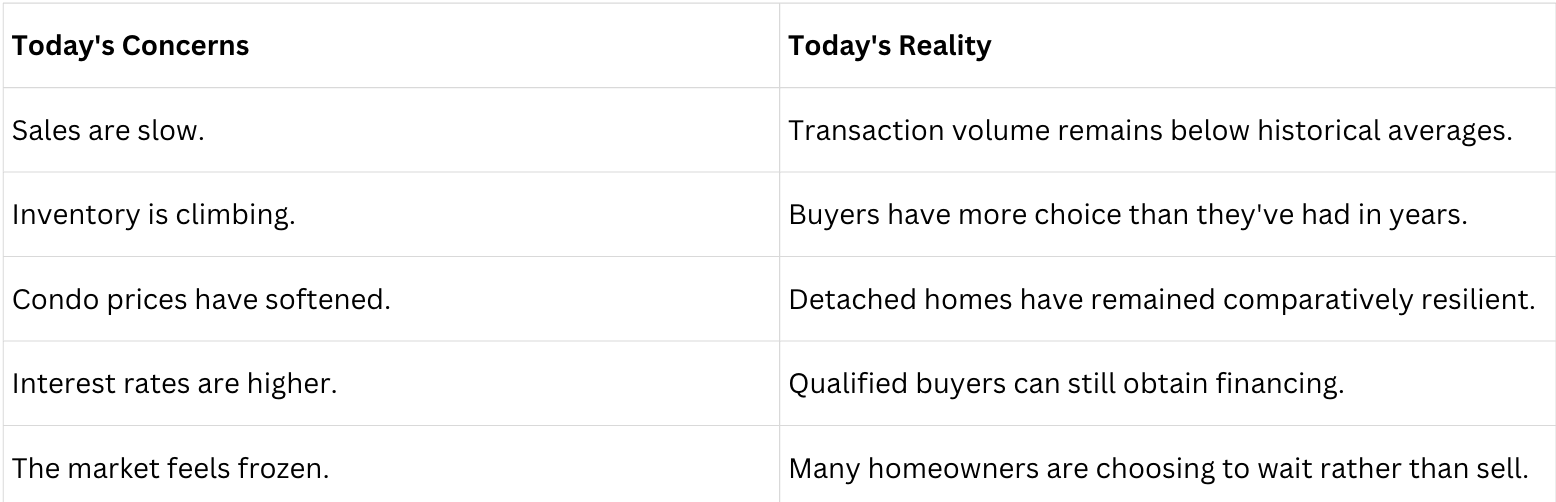 These are legitimate challenges.But they are fundamentally different from a global banking crisis.
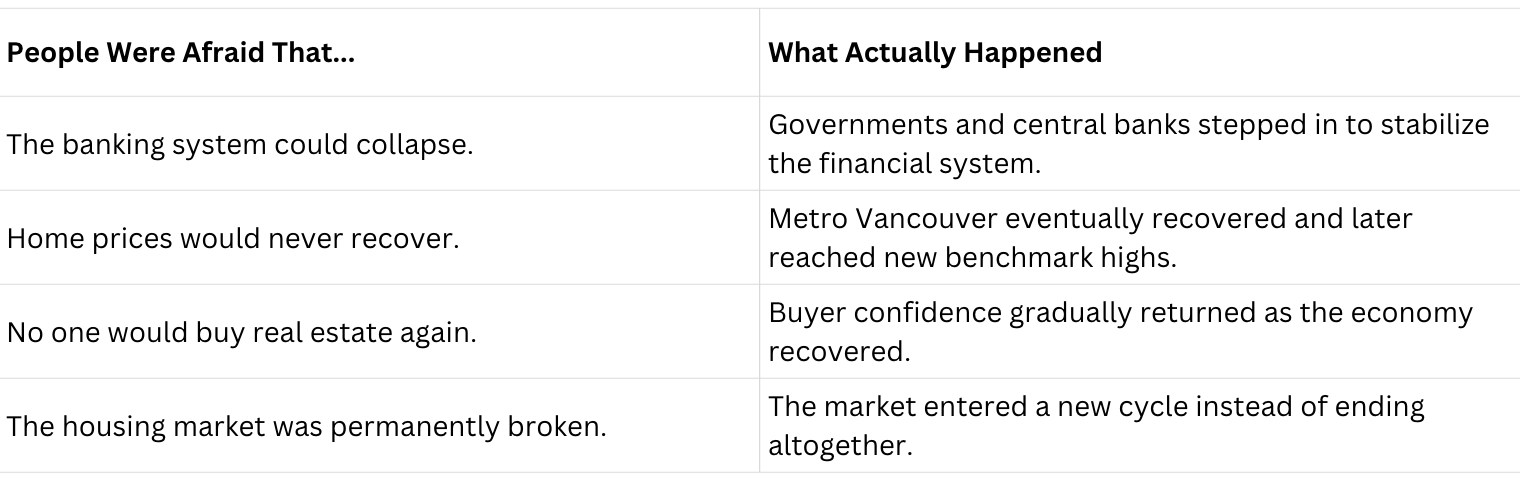
What People Feared in 2008
When we look back at the 2008 Global Financial Crisis, it's easy to remember the recovery. What we often forget is how uncertain everything felt at the time.Many people believed the housing market—and even the financial system itself—might not recover for years.The point isn't that every downturn ends the same way.The point is that 2008 was driven by a global financial crisis, yet the Metro Vancouver housing market eventually recovered.That perspective matters.
What Are People Worried About Today?
Fast forward to 2026, and the concerns sound different.These are legitimate challenges.But they are fundamentally different from a global banking crisis.The Biggest Difference Isn't Prices—It's Risk
This is where I believe many headlines miss the bigger picture.In 2008, the greatest concern wasn't simply that home prices might decline.It was that the global financial system itself was under severe stress.Banks were failing. Credit markets were freezing. Businesses struggled to borrow. Consumer confidence collapsed.Today's market isn't facing those same systemic risks.That said, there is still worldwide uncertainty—whether it's geopolitical tension, trade concerns, or uneven economic growth—but it isn't the same kind of financial crisis that defined 2008.Instead, we're seeing a housing market adjusting to higher borrowing costs, affordability challenges, increased inventory, and more cautious buyers.That's why today's market feels slow rather than chaotic.One Metro Vancouver Market? Not Exactly.
Another common misconception is that the entire market is moving in the same direction.In reality, each property type is telling a different story.Detached Homes: Holding Their Ground
Detached homes continue to be the most resilient segment of the market.Many homeowners have significant equity and aren't under pressure to sell, which has helped support pricing despite slower sales.Townhomes: A Balanced Middle Ground
Townhomes continue to attract families looking for more space while remaining more affordable than detached homes.This segment has generally maintained a healthier balance between supply and demand.Condominiums: More Choice for Buyers
The condo market currently offers buyers the greatest selection.Higher inventory has created more negotiating opportunities, while sellers are finding that accurate pricing and thoughtful presentation matter more than ever.So... Is This Another 2008?
In my view, no.That doesn't mean today's market is easy.It doesn't mean prices can't fluctuate.And it certainly doesn't mean every neighbourhood or property type will perform the same way.What it does mean is that today's challenges stem from different causes than they did in 2008.One was a global financial crisis.The other is a housing market adjusting to changing economic conditions.Those are not the same story.Final Thoughts
History doesn't repeat itself exactly, but it often provides valuable perspective.The Metro Vancouver housing market has weathered a much more severe global crisis before. While today's market presents its own challenges, they're driven by different fundamentals—and that distinction matters.Whether you're buying, selling, investing, or simply trying to understand what's happening, I believe it's important to look beyond the headlines and focus on the underlying data. Because a condo in Burnaby is moving differently than a detached home in Coquitlam, generic advice won't cut it right now. If you want to know exactly what the data means for your specific neighbourhood or property type, send me a message. Let’s look at the numbers together.Every home—and every market segment—has its own story.